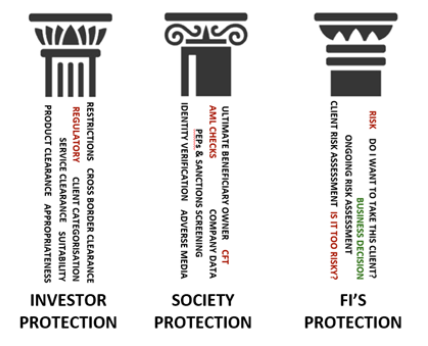
In order to fully onboard a client – meaning, to be legally able to start doing business with that client – a firm needs to perform three main types of actions:
-
Regulatory Classification.
This is mainly relevant to financial institutions (“FI”s), which are required to perform several actions, which are meant to protect their clients. These are mainly Client Categorisation, Suitability and Appropriateness. Getting these right is extremely important to the FI, as wrong regulatory classification can lead to mis-selling, which can then be used to reverse trades (and can even be exploited by experienced investors in their favour). It can also of course lead to complaints, fines, loss of investors’ trust and other unwanted results.
-
KYC/AML checks. These include many different types of checks, including those which are meant to verify one’s identity, meaning, making sure the intended applicant is who they claim to be; and those who are meant to find out additional relevant details which might make onboarding the specific applicant risky or even forbidden. This type of checks include checks to see if the potential client is a Politically Exposed Person (“PEP”), appears on a sanctions list, and many, many others, as you will see further on in this Help Centre.
Getting this stage of the onboarding process right is also very important, not only for the protection of society against money laundering and terror financing, but also to prevent hefty fines and other measures often levied on the firm.
-
Client risk assessment. If the first and second types of actions focused on the protection of the investor and the society, this third type focuses on the protection of the firm itself.
These actions allow the firm to compile a risk profile of the potential client, in order to help it decide whether or not it wants to onboard that person.
We call these three types of actions the “Three Pillars of Onboarding” (each pillar, as explained above, and is also visible in the figure below, revolves around the protection of a different actor in the onboarding arena):